 4BLOCKS
This lesson at a glance
| Pattern | ___이/가 있어요. / 없어요. |
|---|---|
| Meaning | There is ___. / There isn't ___. (also: I have ___ / I don't have ___) |
| Grammar | 있다 / 없다 in the 다 slot · subject tails 이/가 (받침 check) · questions with a rising voice |
| Level | Absolute beginner · TOPIK 1 grammar |
| Words | 숟가락 spoon · 젓가락 chopsticks · 물 water · 컵 cup · 휴지 tissue · 의자 chair · 메뉴 menu · 지갑 wallet · 카드 card · 시간 time |
Where are the spoons? 숟가락이 없어요!
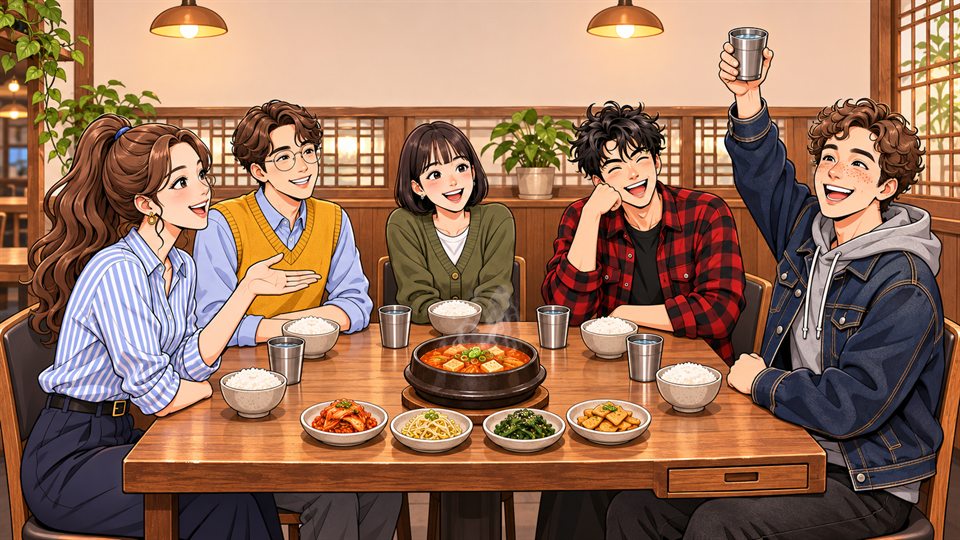
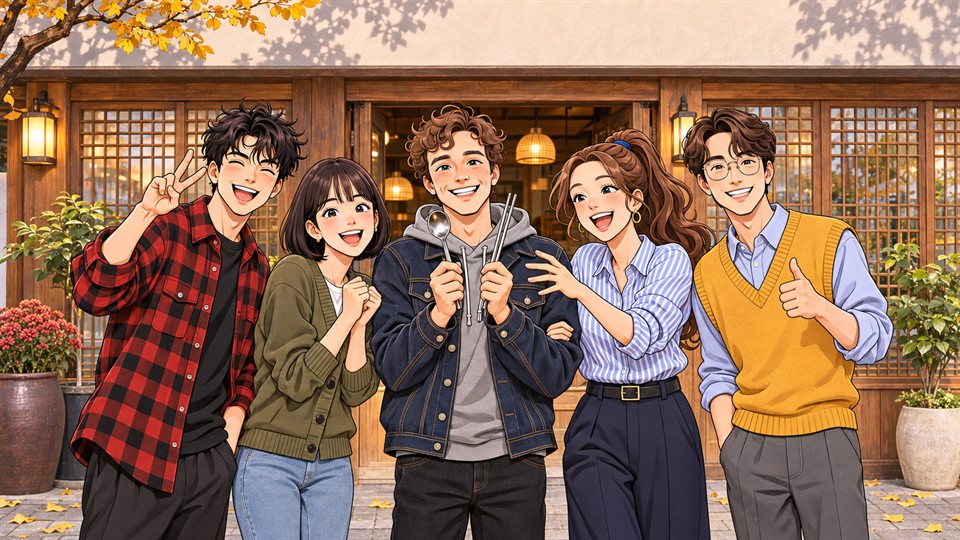
The episode opens at a Korean restaurant near the office. Kimchi stew and rice arrive, and Jake looks around: no spoons anywhere. Hana says 숟가락이 있어요 (There ARE spoons), and Jake shouts 숟가락이 없어요! (There are no spoons!). These two sentences are the whole lesson.
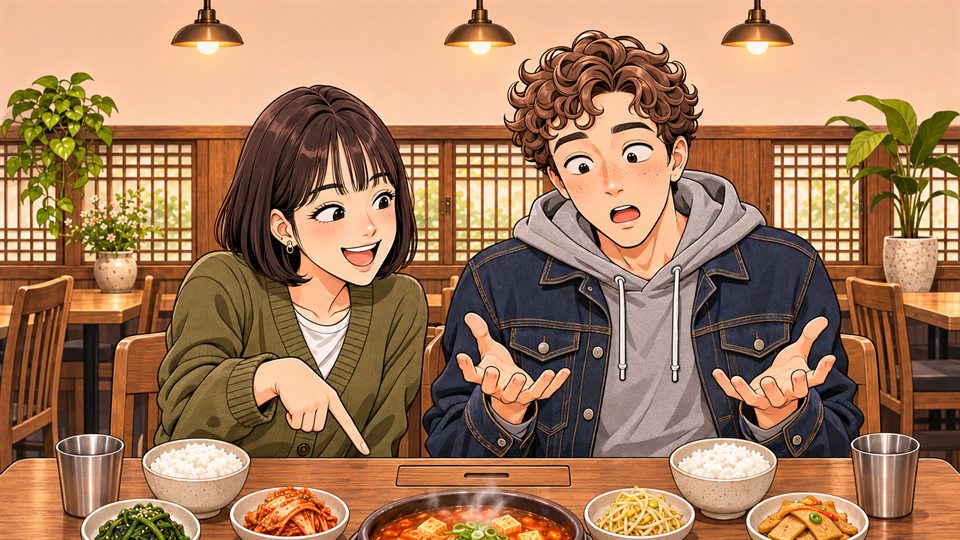
Hana: 숟가락이 있어요. Jake: Where?! 숟가락이 없어요!
Then Mina taps the table: 여기 서랍이 있어요 (There's a drawer here). The secret drawer slides open, full of spoons and chopsticks.
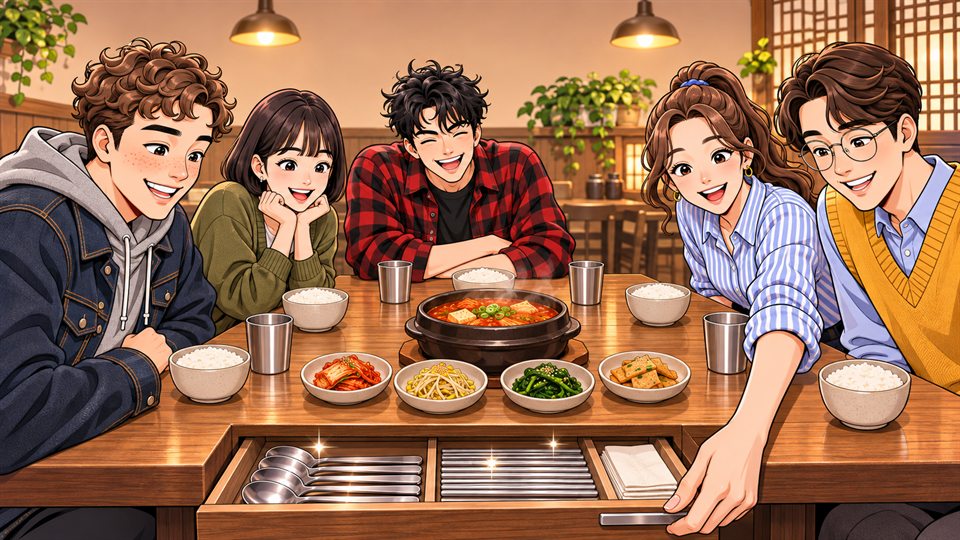
Mina: 짠! 숟가락이 있어요. 젓가락이 있어요.
Step 1: 있다 goes in the 다 slot
In Dan's Block Board, today's block is 있다. It means “there is”, or “to have”. Like every Korean verb, it goes in the 다 slot, at the end of the sentence. In polite speech it becomes 있어요. The opposite is 없다, polite 없어요.
| Dictionary form | Polite form | Meaning |
|---|---|---|
| 있다 | 있어요 | there is / have |
| 없다 | 없어요 | there isn't / don't have |
Note: 있다 is not the be verb. In Ep.1 you learned 이다 (am, is, are), which says what something is: 물은 셀프예요 (Water is self-service). 있다 says that something exists or that you have it.
Step 2: the thing + a little tail, 이 or 가
First say the thing. Then add a little tail, 이 or 가. This is the Korean subject particle. Then 있어요 or 없어요:
숟가락이있어요
숟가락이 있어요. = There are spoons. Two blocks. That's it! Remember 은 and 는 from Ep.1? 이 and 가 are subject tails, too. With 있어요 and 없어요, Koreans usually use 이 or 가.
Step 3: 이 vs 가? Do the 받침 check
It's the same trick as 이에요/예요 and 은/는. Look at the last block of the noun. Does it have a bottom letter (받침, batchim)?
| Last block | Tail | Examples |
|---|---|---|
| has a bottom letter (받침) | 이 | 숟가락이 · 젓가락이 · 물이 · 컵이 · 지갑이 · 시간이 |
| no bottom letter | 가 | 휴지가 · 의자가 · 메뉴가 · 카드가 |
숟가락: the last block 락 has ㄱ at the bottom, so 숟가락이. 휴지: 지 has nothing at the bottom, so 휴지가. Not 휴지이! That is exactly Jake's mistake at the table, when he asks 휴지이... 있어요? and Dan's glasses flash. New to the letters? Start with our Korean alphabet lessons.
Step 4: questions and answers
Want a question? Use the same sentence and just lift your voice at the end ↗.
| 물이 있어요? ↗ | Is there water? |
| 네, 있어요. | Yes, there is. |
| 아니요, 없어요. | No, there isn't. |
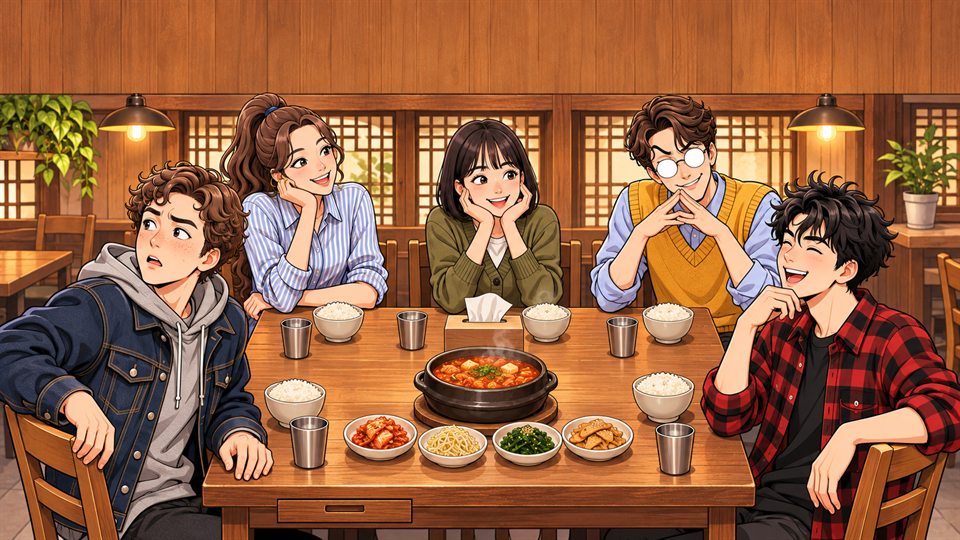
In the answer you can drop the thing and keep only 있어요 or 없어요. Later in the episode, Mina asks 물이 있어요? and Jake proudly lifts his cup: 네, 있어요!
Bonus: 있어요 also means “have”
In English, “there is” (something exists) and “I have” (you own it) are two different things. Korean lumps them together. One word does both jobs: 있어요. So “I have a card” is simply “a card exists (for me)”: 카드가 있어요. The thing you have takes the subject tail 이/가, not the object tail 을/를, so never say “카드를 있어요”.
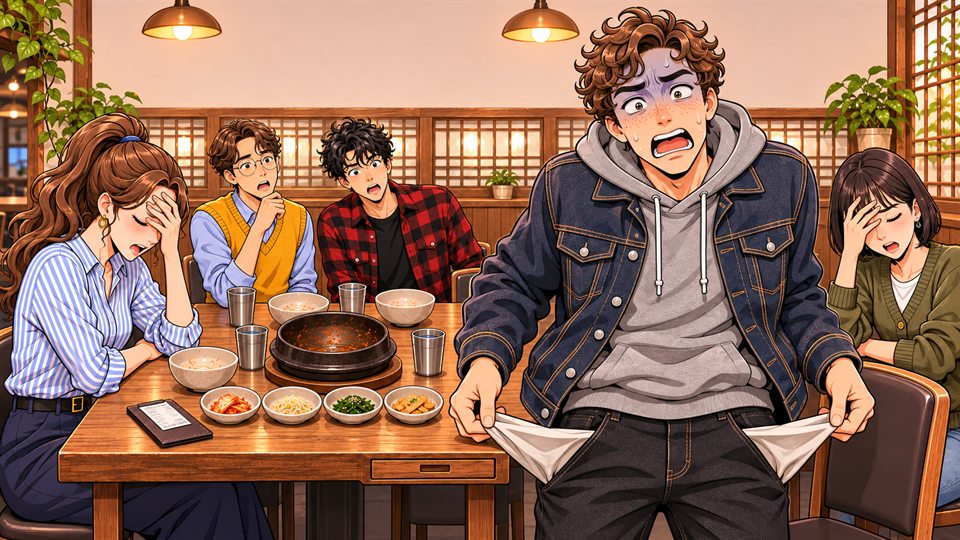
The same verb works for things you have. When the bill comes, Jake finds out 지갑이 없어요! (I don't have my wallet!), and Dan calmly says 괜찮아요. 카드가 있어요. (It's okay. I have a card.)
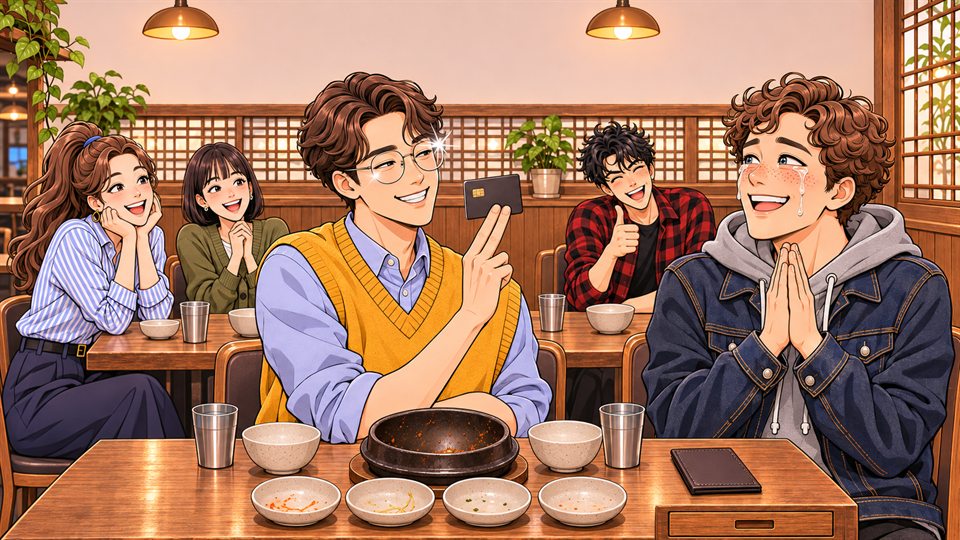
Two more: 시간이 없어요 (I have no time) and 카드가 있어요 (I have a card). There is no “I” in these sentences. Koreans usually leave out 저는 when it's clear.
And WHERE is it? 서랍에 숟가락이 있어요 (There are spoons in the drawer). That little 에 is next time, in Ep.3!
Korean restaurant culture: drawer, 물은 셀프, tissues
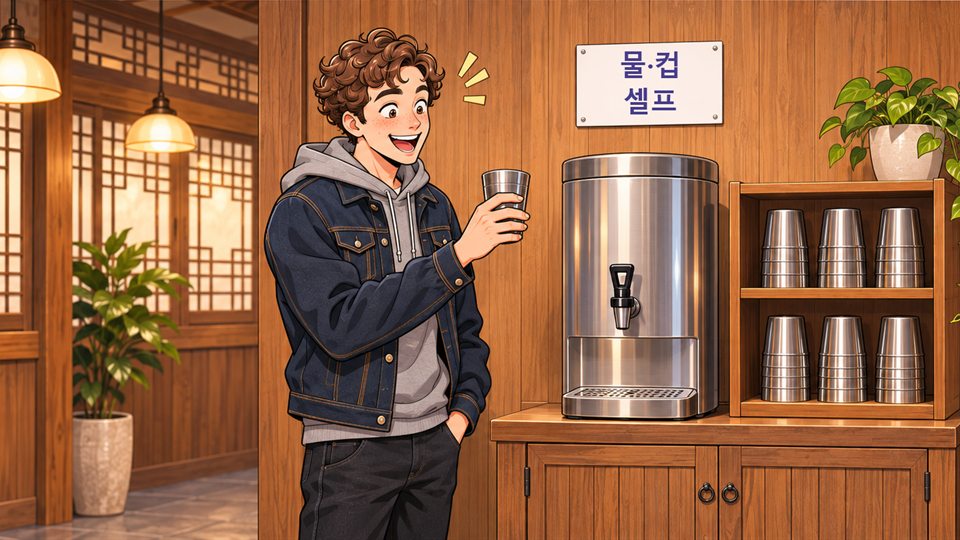
- Spoons and chopsticks are often in a drawer under the table, or in a box on the table.
- 물은 셀프 means water is self-service. Get your own water and cups, usually from a water dispenser (정수기).
- Tissues are often in a box on the table, or on the wall.
Repeat after us: 8 key sentences
| Korean | Romanization | English |
|---|---|---|
| 숟가락이 있어요. | sut-ga-ra-gi i-sseo-yo | There are spoons. |
| 숟가락이 없어요. | sut-ga-ra-gi eop-sseo-yo | There are no spoons. |
| 젓가락이 있어요. | jeot-ga-ra-gi i-sseo-yo | There are chopsticks. |
| 휴지가 있어요. | hyu-ji-ga i-sseo-yo | There are tissues. |
| 물이 있어요? | mu-ri i-sseo-yo? | Is there water? |
| 네, 있어요. | ne, i-sseo-yo | Yes, there is. |
| 지갑이 없어요. | ji-ga-bi eop-sseo-yo | I don't have my wallet. |
| 카드가 있어요. | ka-deu-ga i-sseo-yo | I have a card. |
Notice the sound: the bottom letter slides into 이, so 숟가락이 sounds like “sut-ga-ra-gi” and 물이 like “mu-ri”.
Your turn: what's on your desk?
Look at your desk and answer in Korean: ___이/가 있어요! For example, 커피가 있어요. 휴대폰이 있어요. Post it in the YouTube comments. We read them all!
Common mistakes with 있어요 / 없어요
- 휴지이 있어요. No bottom letter on 지 → 휴지가 있어요.
- 컵가 있어요. 컵 has ㅂ at the bottom → 컵이 있어요.
- 네, 없어요 for “Yes, there is.” Match the answer: 네, 있어요 / 아니요, 없어요.
- Putting 있어요 in the middle. “There are spoons” is not 있어요 숟가락이. The verb goes at the end: 숟가락이 있어요.
10-question practice quiz: 있어요 / 없어요 and 이/가 (TOPIK style)
Answer in your head or out loud, then tap the box to check.
- 물( ) 있어요. 이 or 가?
- 휴지( ) 있어요. 이 or 가?
- What is the opposite of 있어요?
- What does 숟가락이 없어요 mean?
- 의자( ) 없어요. 이, 가 or 을?
- Make it a question: 물이 있어요.
- A: 숟가락이 있어요? B (yes): ?
- Fix the mistake: 휴지이 있어요.
- What does 카드가 있어요 mean?
- You see a sign: 물은 셀프. What do you do?
TOPIK-style practice written by 4BLOCKS KOREAN (not official TOPIK questions).
Free printable worksheet: there is / there isn't in Korean
Four roomy pages: the 이/가 받침 sort, fill in 이 or 가, picture questions with 있어요/없어요, questions and answers, pair work with a friend (물이 있어요? 네, 있어요.), a 물은 셀프 culture check, “What's on your desk?” writing, and a 10-question test. The answer key is a separate PDF. Free for self-study and classrooms.
FAQ: there is / there isn't in Korean
How do you say “there is” in Korean?
Thing + 이/가 + 있어요: 숟가락이 있어요, 휴지가 있어요.
How do you say “there isn't” in Korean?
Use 없어요: 숟가락이 없어요, 물이 없어요.
When do you use 이 and when do you use 가?
Bottom consonant (받침) → 이 (물이, 컵이). No bottom consonant → 가 (휴지가, 의자가).
Does 있어요 also mean “have”?
Yes. English splits “there is” and “have”, but Korean lumps them together into one word, 있어요. 카드가 있어요 = I have a card. 시간이 없어요 = I have no time.
What does 물은 셀프 mean in a Korean restaurant?
Water is self-service: get your own water and cups.