 4BLOCKS
Hangul Sounds: the Korean alphabet, one letter at a time
Each lesson has a short video with our teacher, a side view of the mouth, a chant and a free printable worksheet.
ㄱ is a picture of your tongue
How to pronounce ㄱ (g/k), 4 easy words, a chant and a worksheet.
#2ㄴ is NOT an L!
How to pronounce ㄴ (n), 4 easy words, a chant and a worksheet.
#3ㅁ is your mouth
How to pronounce ㅁ (m), 4 easy words, a chant and a worksheet.
#4ㅅ is a tooth
How to pronounce ㅅ (s), 4 easy words, a chant and a worksheet.
#5ㅇ is SILENT
Why the circle letter makes no sound at the start of a syllable.
#6Korean vowels are just 3 pieces
The flat line ㅡ, the standing line ㅣ and the dot that builds every vowel.
#7Move one dot, change the sound
ㅏ (a) vs ㅓ (eo): the vowel pair English speakers mix up most.
#8Up or down? ㅗ vs ㅜ
ㅗ (o) and ㅜ (u): read the dot's direction and you know the sound.
#9 · NEWAdd one more dot = add a y
ㅑ ㅕ ㅛ ㅠ (ya, yeo, yo, yu): one extra stroke turns a vowel into a y-sound.
How to build a Korean sentence with 4 blocks
Most Korean courses give you phrases to memorize. 4BLOCKS gives you a frame instead, so you can make your own sentences from day one. Every Korean word you learn is one of 4 colored blocks, and every Korean sentence has up to 4 slots.
The 4 blocks (word types)
noun blue: people, things, places (저, 커피, 학교)
adjective green: words that describe a noun
adverb yellow: when, where, how (오늘, 학교에서)
verb red: actions and states (먹다, 마시다, 있다)
The 4 slots (Korean particles)
은 slot: who or what the sentence is about (은/는, 이/가)
을 slot: the object, what you do it to (을/를)
로 slot: what something is or becomes
다 slot: the verb, always at the very end
Example 1: I drink coffee
저는커피를마셔요
저는 커피를 마셔요. 저 (I) sits in the 은 slot and gets the tail 는. 커피 (coffee) sits in the 을 slot and gets the tail 를. 마셔요 (drink) goes in the 다 slot at the end. English says “I drink coffee”, Korean says “I coffee drink”. Once you see the slots, the word order stops being strange.
Example 2: the blocks can move
커피를저는마셔요
Because each block carries its own tail (는, 를), Korean speakers can swap the first blocks and the meaning stays the same. In English, “Coffee drinks I” is nonsense. In Korean, 커피를 저는 마셔요 is still “I drink coffee.” Only the 다 block has to stay at the end.
Example 3: I am Jake
저는제이크예요
저는 제이크예요. Korean has a word for “am / is / are”: the be verb 이다. Like every verb, it goes in the 다 slot at the end, and in polite speech it becomes 이에요 or 예요. So “I am Jake” becomes “I Jake am.” This is the first lesson of our sitcom, Jake at 4BLOCKS.
Each lesson on this site shows its Korean sentences in these colors, and our 다 Challenge series shows how the red 다 block changes shape: present, past, negative, question and “let's”.
Where to start: a simple path for beginners
Read Hangul
Learn the Korean alphabet with Hangul Sounds, watch letters snap into syllable blocks in Hangul Assembly, and test yourself with Can You Read This? Most learners can read slowly within one or two weeks.
STEP 2First words and sentences
Build sentences with the 4 blocks: verb forms in the 다 Challenge, everyday grammar in our sitcom Jake at 4BLOCKS, cooking Korean with Grace's Tiny Kitchen and nursery rhymes.
STEP 3Real-life Korean
Read real street signs in Korea Street Walk, follow easy Korea Shock News, learn about Korea in numbers, and sing along with ballads and raps.
Korean Sitcom: Jake at 4BLOCKS
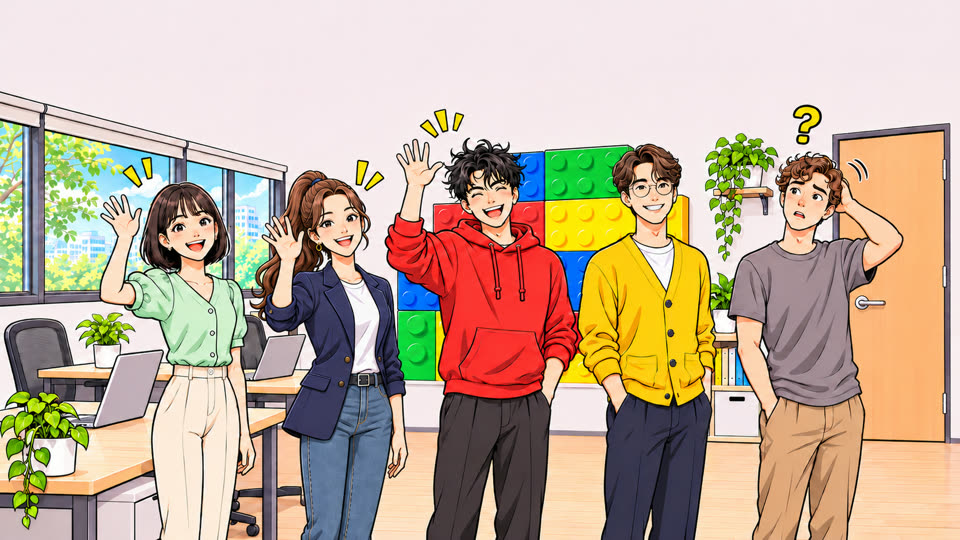
Jake is an American intern at a Korean office. Every episode, he makes a mistake and learns one piece of Korean grammar, with a TOPIK-style quiz and a free worksheet.
 EP.1
How to introduce yourself in Korean: 저는 ___이에요/예요
이에요 vs 예요, 은 vs 는, polite 요, and why you never put 님 on yourself.
 EP.2
How to say “there is” in Korean: 있어요 / 없어요
Why Korean uses one word for “there is” and “I have”, plus the subject tail 이/가.
 EP.3 · NEW
How to say “where is” in Korean: 에 있어요
Location words 안·위·밑·옆·앞·뒤 in a Korean convenience store.
More free series
Every video on our channel has a lesson page with a 10-question quiz and a printable worksheet. See them all in the Library →
Watch letters snap into blocks
Build 감사합니다 (thank you) letter by letter.
CAN YOU READ THIS?Konglish words you already know
Read 5 Korean words in 3 seconds each.
다 CHALLENGEOne verb, 5 forms
Present, past, negative, question and “let's”.
KOREA STREET WALKRead real Korean signs
A 10-minute walk with a final quiz.
KOREA SHOCK NEWSLearn Korean from real news
Shocking news in easy English, one Korean headline and 3 words.
GRACE'S TINY KITCHENLearn Korean by cooking
Easy Korean recipes, cooking verbs and a free recipe card.
KOREAN HEALING BALLADSLearn Korean with songs
Watercolor K-drama style ballads: lyrics, sound linking and sing-along.
KOREAN RAPLearn Korean with rap
Cynical office raps: casual vs polite Korean, line by line, then rap along.
FREE CHARTKorean Alphabet Chart
All Hangul letters with pronunciation, plus a free printable PDF chart.
KOREAN FOLK SONGSK-pop nursery rhymes
Sing and dance traditional Korean children's songs with the 4BLOCKS Crew.
KOREA IN NUMBERS · NEWLearn about Korea in numbers
One real statistic about life in Korea, told with easy Korean sentences.
DAILY KOREAN · NEWKorean for everyday life
Small phrases you need in Korea, like calling the waiter with 여기요.
What is your name in Korean?
Type your name and watch it snap together in Hangul, block by block. Then hear how a Korean speaker says it.
Why learn Korean with 4 blocks?
🧱 Structure first
Nouns, adjectives, adverbs and verbs are 4 colored blocks. Korean particles 은 · 을 · 로 · 다 are the 4 slots. You stop memorizing phrases and start making your own sentences.
👅 Letters you can see
Hangul consonants are pictures of your tongue, lips and throat. Once you see the picture, you can read the letter.
🎵 Chants and missions
Short, fun videos with chants and real situations in Korea, so the sounds and phrases stick.
Frequently asked questions
Is Korean hard for English speakers?
Korean grammar is very different from English, which is what makes it feel hard. The good news is that it follows a few clear rules. The verb always goes at the end, and small tails like 는 and 를 show each word's job. Once you see those rules as 4 slots, Korean becomes much easier to build than to memorize.
Should I learn Hangul before anything else?
Yes. Hangul has only 24 basic letters and was designed to be easy, so most beginners can read slowly within one or two weeks. Romanization (writing Korean in English letters) gets in the way of good pronunciation. Start with Hangul Sounds #1: ㄱ or the Korean alphabet chart.
How long does it take to learn Korean?
Reading Hangul takes days or a few weeks. Simple sentences like 저는 커피를 마셔요 (I drink coffee) take a few weeks of short daily practice. Holding real conversations usually takes many months. 10 to 15 minutes a day with videos, a chant and a worksheet works better than one long session a week.
Why does Korean put the verb at the end?
Korean is a subject-object-verb language, like Japanese and Turkish. English says “I drink coffee”, Korean says 저는 커피를 마셔요, literally “I coffee drink”. In 4BLOCKS, the verb always goes in the last slot, called the 다 slot, so you always know where it goes.
Are the lessons and worksheets really free?
Yes. Every video on our YouTube channel has a free lesson page with a 10-question quiz, a printable PDF worksheet and a separate answer key. You can find them all in the Library. Our teachers are AI characters, and the lessons are written and checked by the 4BLOCKS KOREAN team.
Free Hangul worksheets in your inbox
Get an email each time a new lesson and printable worksheet is ready, plus the full Hangul Starter Pack when it is complete.