 4BLOCKS
This song at a glance
| Song | 창가에 불을 켜 둘게요 I'll Leave a Light by the Window |
|---|---|
| Mood | Waiting and missing someone · first snow · warm tea · a K-drama OST style healing ballad (2:46) |
| Grammar | -ㄹ게요 / -을게요 (I'll…, a promise) · -아/어 두다 (do and keep it that way) · -아/어도 괜찮아요 (it's okay to…) · dropped subjects |
| Sounds | 연음 (sound linking): 손에 [소네] · 있어요 [이써요] · 첫눈 [천눈] · 괜찮아요 [괜차나요] |
| Level | Beginner · good after you can read Hangul |
| Words | 찻잔 teacup · 김 steam · 손 hand · 창문 window · 입김 breath · 첫눈 first snow · 의자 chair · 차 tea · 불 light · 창가 by the window · 골목 alley · 길 way · 사진 photo · 시계 clock |
Full lyrics: Korean, romanization and English
Romanization is only a reading aid. Listen to the song for the real sound (see the 연음 section below).
Verse 1
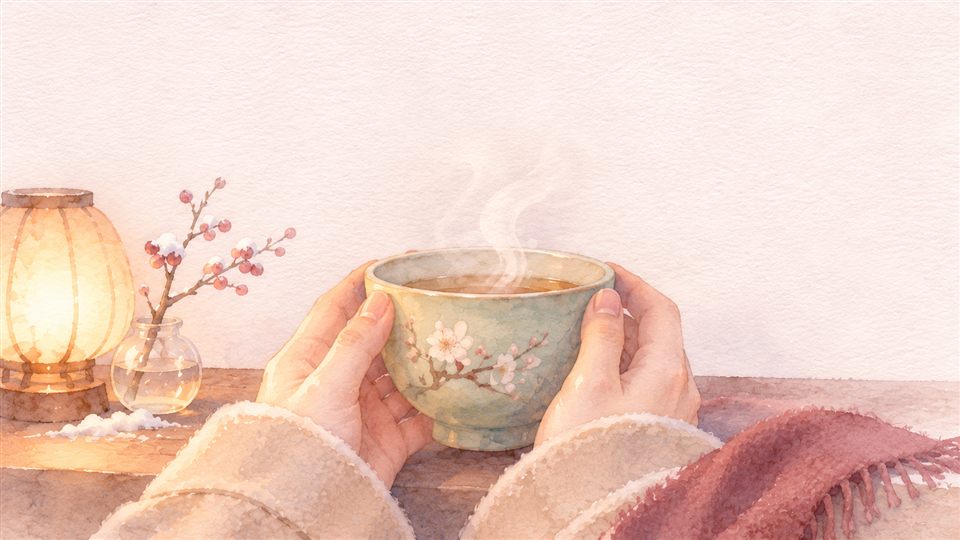
찻잔에서 따뜻한 김이 올라요Chatjaneseo ttatteuthan gimi ollayoWarm steam rises from the teacup.
두 손에 온기가 번져요Du sone ongiga beonjyeoyoWarmth spreads through both hands.
창문에 맺힌 입김을 닦아요Changmune maechin ipgimeul dakkayoI wipe the mist of my breath from the window.
첫눈이 작은 지붕을 덮어요Cheonnuni jageun jibungeul deopeoyoThe first snow covers the little roof.
Pre-chorus
지금 어디쯤 오고 있나요Jigeum eodijjeum ogo innayoWhere are you on your way here now?
빈 의자를 곁으로 당겨요Bin uijareul gyeoteuro danggyeoyoI pull the empty chair closer to me.
네 자리를 비워 둘게요Ne jarireul biwo dulgeyoI'll keep a place open for you.
식은 차를 다시 데워요Sigeun chareul dasi dewoyoI warm the tea again after it has cooled.
Chorus (sung 3 times)
불을 켜 둘게요Bureul kyeo dulgeyoI'll leave the light on.
이 창가에서 기다릴게요I changgaeseo gidarilgeyoI'll wait by this window.
하얀 눈이 골목을 덮어도Hayan nuni golmogeul deopeodoEven if white snow covers the alley,
따뜻한 차가 여기 있어요Ttatteuthan chaga yeogi isseoyothere is warm tea here.
천천히 와도 정말 괜찮아요Cheoncheonhi wado jeongmal gwaenchanayoIt's really okay to take your time coming.
돌아올 길을 비춰 둘게요Doraol gireul bichwo dulgeyoI'll keep the way back lit for you.
불을 켜 둘게요Bureul kyeo dulgeyoI'll leave the light on.
이 창가에서 기다릴게요I changgaeseo gidarilgeyoI'll wait by this window.
Verse 2
시계 소리만 방을 채워요Sigye soriman bangeul chaewoyoOnly the sound of the clock fills the room.
네 사진을 곁에 놓아요Ne sajineul gyeote noayoI place your photo beside me.
좁은 골목에 눈이 쌓여요Jobeun golmoge nuni ssayeoyoSnow piles up in the narrow alley.
익숙한 웃음이 문득 그리워요Iksukan useumi mundeuk geuriwoyoAll at once, I miss your familiar smile.
Bridge
늦은 밤도 함께 나눌게요Neujeun bamdo hamkke nanulgeyoI'll share even the late hours with you.
말이 없어도 함께 있을게요Mari eopseodo hamkke isseulgeyoI'll stay with you even in silence.
네 이야기를 천천히 들을게요Ne iyagireul cheoncheonhi deureulgeyoI'll take my time listening to your story.
차가운 손을 가만히 감쌀게요Chagaun soneul gamanhi gamssalgeyoI'll gently wrap your cold hands in mine.
Final chorus
The chorus once more, with the music opening up: 불을 켜 둘게요. 이 창가에서 기다릴게요.
Line by line: the 4 blocks of each lyric
Every Korean sentence is built from 4 kinds of blocks, and the action word always comes last, in the 다 slot. The color tells you what the block is. The small tag tells you which slot it fills: 은 (who or what), 을 (the object), 로 (where, when, how) and 다 (the action). A dashed block is a word Korean leaves out.
The colors match the video: blue for things, red for actions, green for describing words and yellow for words that tell how, when or where. Every word in every line is explained, just like in the lesson part of the video.
찻잔 is a teacup, and 에서 means “from”. 따뜻한 means warm. 김 is steam. 올라요 means it rises.
두 means two, and 손 is hand. 에 means “in”. 온기 is warmth. 번져요 means it spreads, like ink on paper.
창문 is a window. 맺힌 means “formed”, like drops on glass. 입김 is the white breath you see on a cold day, here the mist it leaves on the glass. 닦아요 means “I wipe it”.
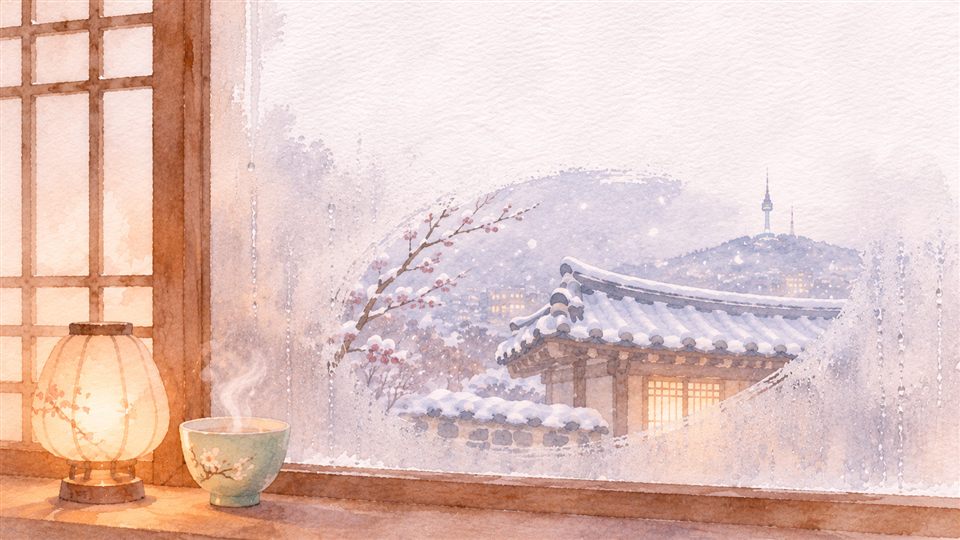
첫눈 is the first snow of winter, and Koreans love it. 작은 means small, and 지붕 is a roof. 덮어요 means it covers.
지금 means now. 어디쯤 means “about where”. 오고 있나요 is a soft way to ask “are you coming?”
빈 means empty, and 의자 is a chair. 곁으로 means “to my side”. 당겨요 means “I pull”.
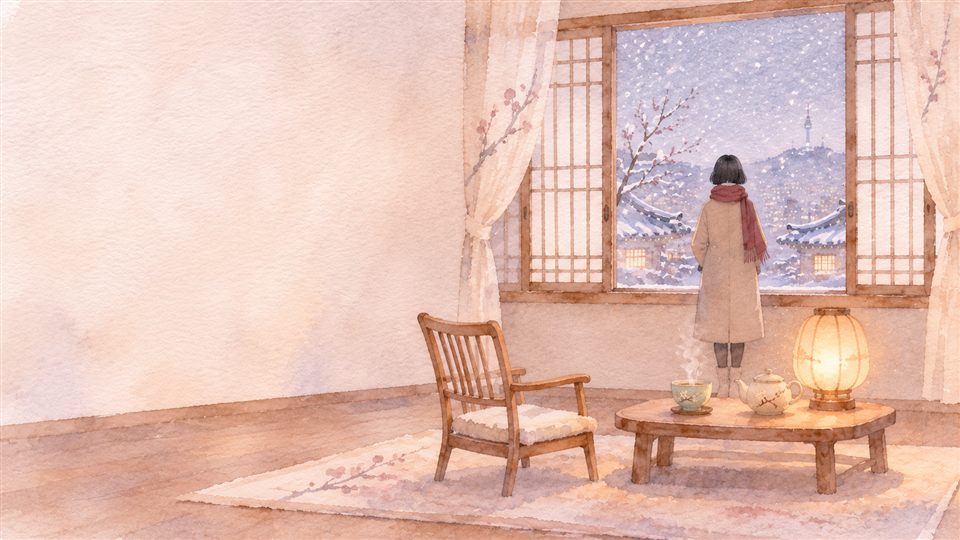
네 means your, and 자리 is a seat. 비워 둘게요 means “I'll keep it empty”. The ending 게요 makes a promise.
식은 means “gone cold”, and 차 is tea. 다시 means again. 데워요 means “I warm it up”.
The title line. 불 is a light, and 켜요 means “turn on”. 켜 둘게요 means “I'll leave it on”. Another promise.
이 means this. 창가 is the spot by the window, and 에서 means “at”. 기다릴게요 means “I'll wait”.
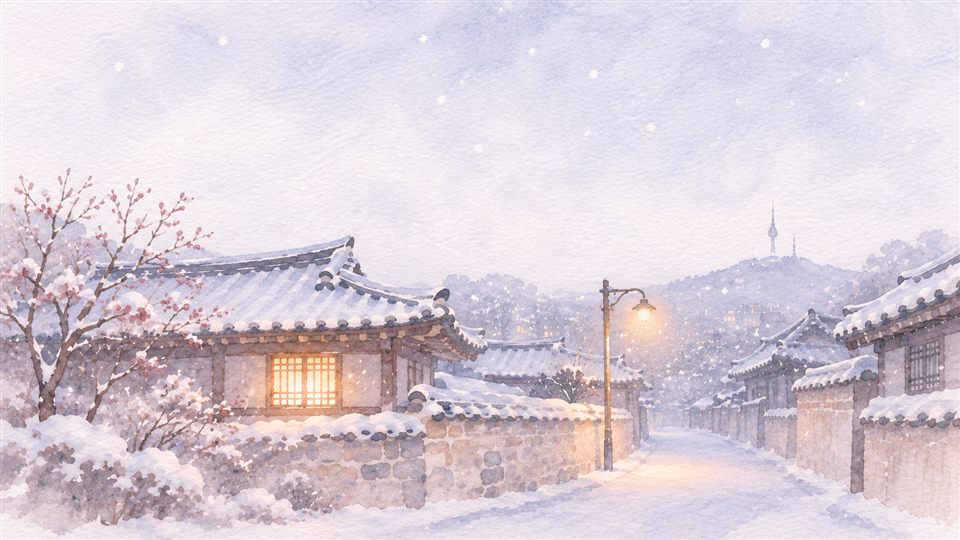
하얀 means white, and 눈 is snow. 골목 is a narrow alley. 덮어도 means “even if it covers”.
따뜻한 차 is warm tea. 여기 means here. 있어요 means “it is there”. Warm tea is here, waiting for you. (More on 있어요 in our “there is” lesson.)
천천히 means slowly. 와도 means “even if you come”. 정말 means really. 괜찮아요 means “it's okay”. Take your time. (괜찮아요 is a describing word, and in Korean a describing word can sit in the 다 slot too.)
돌아올 means “to come back”, and 길 is a road. 돌아올 길 is the way back. 비춰 둘게요 means “I'll keep it lit”.
Verse 2 and bridge: every word
시계 is a clock, and 소리 is sound. 만 means “only”. 방 is a room. 채워요 means it fills.
네 사진 is your photo. 곁에 means beside me. 놓아요 means “I put it”.
좁은 means narrow. 골목 is an alley, and 에 means “in”. 눈 is snow. 쌓여요 means it piles up.
익숙한 means familiar, and 웃음 is a smile. 문득 means suddenly. 그리워요 means “I miss it”.
늦은 means late, and 밤 is night. 도 means “even”. 함께 means together. 나눌게요 means “I'll share”.
말 is words. 없어도 means “even if there are none”. 함께 있을게요 means “I'll stay with you”.
네 이야기 is your story. 천천히 means slowly. 들을게요 means “I'll listen”.
차가운 means cold, and 손 is hand. 가만히 means gently and quietly. 감쌀게요 means “I'll wrap them”.
Where are “I” and “you”? Korean drops the subject
Here's a secret: almost no line in this song says “I” or “you”. Korean leaves out the subject when it is clear who is talking. In a promise like 기다릴게요 (I'll wait), the person promising is always the speaker, so 나는 is not needed. In 천천히 와도 괜찮아요 (It's okay to come slowly), the one coming is the listener, so 너는 disappears too. When you read the lyrics, ask yourself “who does this?” and the meaning becomes clear. In everyday conversation it works the same way: 저는 or 나는 usually drops once everyone knows who you mean, as Jake learns in Sitcom Ep.1.
Grammar 1: -ㄹ게요 means “I'll…” (a promise)
Count them: 둘게요, 기다릴게요, 나눌게요, 있을게요, 들을게요, 감쌀게요. So many lines end with 게요. This ending is how Koreans make a promise or a kind offer to the person they are talking to. It is always about the speaker's own action.
| Verb stem ends in… | Add | Examples from the song |
|---|---|---|
| a vowel | ㄹ게요 | 두다 → 둘게요 · 기다리다 → 기다릴게요 · 나누다 → 나눌게요 · 감싸다 → 감쌀게요 |
| a consonant | 을게요 | 있다 → 있을게요 · 듣다 → 들을게요 (듣다 changes ㄷ to ㄹ) |
Many promises in the song also use -아/어 두다, “do it and keep it that way”: 켜 두다 (turn on and leave on), 비워 두다 (keep empty), 비춰 두다 (keep lit). Put the two together and you get the title: 불을 켜 둘게요, “I'll leave the light on (for you).”
Try your own: 전화할게요 (I'll call you), 갈게요 (I'll go / I'm coming), 도와줄게요 (I'll help you). Note: you can't use -ㄹ게요 for someone else. To say what a friend will do, Korean uses a different ending, -ㄹ 거예요.
Grammar 2: -아/어도 괜찮아요 means “it's okay to…”
The kindest line in the chorus is 천천히 와도 정말 괜찮아요. 오다 (to come) becomes 와도, “even if you come”, and 괜찮아요 means “it's okay”. Together, -아/어도 괜찮아요 gives permission or comfort without pushing: it's okay to take your time. You can build more right away: 앉아도 괜찮아요 (It's okay to sit), 늦어도 괜찮아요 (It's okay to be late).
Without 괜찮아요, -아/어도 alone means “even if”: 하얀 눈이 골목을 덮어도, “even if white snow covers the alley”, and 말이 없어도, “even without words”.
Korean pronunciation linking (연음): sing it the way it sounds
In songs, Korean sounds flow together. When a syllable ends in a consonant and the next one starts with the silent ㅇ, the last sound slides over into the next vowel. (Why is ㅇ silent at the start? See our ㅇ lesson.) A few words also change their sound. You write one thing and sing another:
| You write | You hear | What happens |
|---|---|---|
| 김이 | [기미] | ㅁ slides into 이: gi-mi |
| 손에 | [소네] | ㄴ slides into 에: so-ne |
| 입김을 | [입끼믈] | ㄱ gets strong (ㄲ) after ㅂ, then ㅁ slides into 을 |
| 닦아요 | [다까요] | the double ㄲ slides into 아: da-kka-yo |
| 덮어요 | [더퍼요] | ㅍ slides into 어: deo-peo-yo |
| 첫눈 | [천눈] | ㅅ before ㄴ turns into ㄴ: cheon-nun |
| 있어요 | [이써요] | the double ㅆ slides into 어: i-sseo-yo |
| 괜찮아요 | [괜차나요] | ㅎ goes silent, ㄴ slides into 아: gwaen-cha-na-yo |
| 기다릴게요 | [기다릴께요] | after ㄹ, 게요 sounds like 께요: gi-da-ril-kke-yo |
| 감쌀게요 | [감쌀께요] | the same: gam-ssal-kke-yo |
So you write 첫눈 but say 천눈, and you write 괜찮아요 but say 괜차나요. Keep the spelling when you write, and follow the sound when you sing. This is the same reason K-pop and K-drama OST lyrics sound “faster” than they look on paper.
Sing along: the chorus in 3 steps
- Listen to the chorus once with the lyrics on this page.
- Speak each line slowly, linking the sounds: 불을 켜 둘게요 · 이 창가에서 기다릴게요 (불을 sounds like [부를], and 기다릴게요 like [기다릴께요]).
- Sing with the music video. In the last part of the video some words are hidden. Can you sing 둘게요, 기다릴게요, 첫눈, 괜찮아요, 그리워요, 함께 without looking?
Common mistakes
- Writing it the way it sounds. 괜차나요 and 천눈 are how you hear it. Write 괜찮아요 and 첫눈.
- Using -ㄹ게요 for other people. 친구가 기다릴게요 is wrong. -ㄹ게요 is only for your own promise: 제가 기다릴게요 (I'll wait).
- Asking with -ㄹ게요. To offer, ask with -ㄹ까요: 기다릴까요? (Shall I wait?). Promise with -ㄹ게요: 기다릴게요.
- Forgetting 을 after a consonant. 있게요 → 있을게요. 듣게요 → 들을게요.
10-question practice quiz: 불을 켜 둘게요
Answer in your head or out loud, then tap the box to check.
- What does 불을 켜 둘게요 mean?
- 이 창가에서 ______. (I'll wait.)
- Which word means “the first snow”?
- Which word means “I miss it”: 그리워요 or 데워요?
- 천천히 와도 정말 ______. (It's really okay.)
- How does 첫눈 sound?
- How does 괜찮아요 sound?
- How does 손에 sound?
- Make a promise: 가다 (to go) → ?
- 네 자리를 비워 둘게요. Who keeps the seat empty, I or you?
Free printable worksheet: Korean song lyrics for beginners
Four roomy pages: fill in the missing chorus lyrics, match Korean and English lines, write how each word sounds (연음), make -ㄹ게요 verbs and write your own promises, “it's okay to…” sentences, and a 10-question test. The answer key is a separate PDF. Free for self-study and classrooms.
FAQ: learn Korean with this ballad
What does 불을 켜 둘게요 mean?
“I'll leave the light on.” 켜 두다 = turn on and keep on, -ㄹ게요 = I'll (a promise). The “I” is dropped.
What does -ㄹ게요 mean in Korean?
A polite “I'll…” for promises and offers: 기다릴게요 (I'll wait), 있을게요 (I'll stay). Only for your own action, not in questions.
Why do Korean song lyrics sound different from how they are written?
Sound linking (연음): a final consonant slides into the next vowel (손에 [소네], 있어요 [이써요]), and some sounds change (첫눈 [천눈], 괜찮아요 [괜차나요]).
Why are there no “I” or “you” in these lyrics?
Korean drops the subject when it is clear. A promise (-ㄹ게요) is always “I”, and permission (와도 괜찮아요) is for “you”.
Is this a real K-drama OST?
No. It is an original song for Korean learners in the style of a K-drama OST healing ballad, made with AI tools and checked by our team (see below).
About this song: 창가에 불을 켜 둘게요 is an original song made for learners. Lyrics written with ChatGPT (AI) and checked by our team, music made with Google Flow Music (AI), watercolor illustrations and voices made with AI.