 4BLOCKS
This song at a glance
| Song | 꼬마야 꼬마야 Hey, Little One (a Korean jump-rope song) |
|---|---|
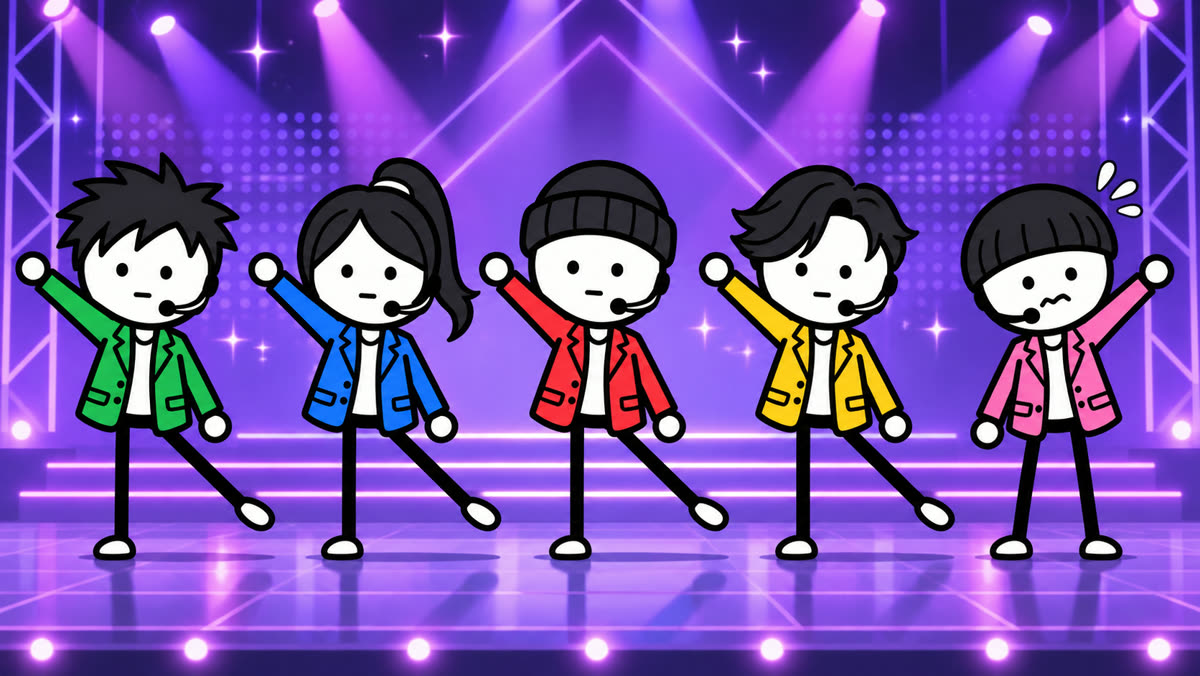
| Style | Traditional Korean nursery rhyme turned into a funky co-ed K-pop song (2:29) with a 5-member dance crew |
| Grammar | -아라 / -어라 (plain commands: Turn! Lift!) · 을/를 + action · calling someone with -야/-아 |
| Sounds | 돌아라 [도라라] · 짚어라 [지퍼라] · 들어라 [드러라] · 발을 [바를] |
| Level | Beginner · good once you can read Hangul |
| Words | 꼬마 little kid · 뒤 back · 돌다 to turn · 땅 ground · 짚다 to press your hand on · 한 one · 두 two · 발 foot · 들다 to lift · 만세 hooray · 부르다 to call out · 잘 well · 가다 to go |
Full lyrics: Korean, romanization and English
The whole song is six lines that start with 꼬마야 꼬마야. Romanization is only a reading aid; listen to the song for the real sound.
Verse (sung twice)
꼬마야 꼬마야 뒤를 돌아라Kkomaya kkomaya dwireul doraraHey, little one, hey, little one, turn around!
꼬마야 꼬마야 땅을 짚어라Kkomaya kkomaya ttangeul jipeoraHey, little one, touch the ground!
꼬마야 꼬마야 한 발을 들어라Kkomaya kkomaya han bareul deureoraHey, little one, lift one foot!
꼬마야 꼬마야 두 발을 들어라Kkomaya kkomaya du bareul deureoraHey, little one, lift both feet! (Jump!)
Chorus (sung twice)
꼬마야 꼬마야 만세를 불러라Kkomaya kkomaya mansereul bulleoraHey, little one, shout hooray!
꼬마야 꼬마야 잘 가거라Kkomaya kkomaya jal gageoraHey, little one, goodbye, go well!
Ending
잘 가거라!Jal gageora!Goodbye!
Line by line: what each word means
Every line has the same shape: a call, then a thing (the 을 slot, blue), then an action (the 다 slot, red). The action always comes last in Korean. These are the same colors you see in the music video lyrics.
꼬마 is a little kid. Add -야 to call someone you are close to: 민수야! After a consonant it is -아: 지민아! The crew calls the jumper “little one” the whole song.
뒤 is the back side, 돌다 is “to turn”. 뒤를 돌아라: Turn around! (The maknae turns twice.)
땅 is the ground. 짚다 means to press your hand on something, like when you squat down. 땅을 짚어라: Touch the ground!
한 is “one” (before a counted thing), 발 is foot, 들다 is “to lift”. 한 발을 들어라: Lift one foot!
두 is “two”. Lift both feet at once… that means jump!
만세 is a cheer, like “hooray!”, with both arms up. 부르다 means to call out or sing, and it changes to 불러라.
잘 means well, 가다 means to go. 잘 가거라 is an old, song-like “Goodbye, go well!” In the game, it tells the jumper to leave the rope.
Grammar: -아라 / -어라 makes a command
Look at the end of each line: 돌아라, 짚어라, 들어라, 불러라. This ending turns a verb into a plain command, “Do it!”. Take the verb stem (drop 다) and look at its last vowel:
| Last vowel | Add | From the song |
|---|---|---|
| ㅏ or ㅗ | 아라 | 돌다 → 돌아라 (Turn!) |
| any other vowel | 어라 | 짚다 → 짚어라 · 들다 → 들어라 |
| special | 부르다 → 불러라 (르 becomes ㄹ러) · 가다 → 가거라 (old form of 가라) |
You hear -아라/-어라 in songs, children's games, old stories and headlines. In real conversation, Koreans choose a different level:
| Song | With friends | Polite |
|---|---|---|
| 돌아라 | 돌아! | 도세요 |
| 짚어라 | 짚어! | 짚으세요 |
| 들어라 | 들어! | 드세요 |
| 잘 가거라 | 잘 가! | 안녕히 가세요 |
Notice the pattern in every line: something + 을/를, then an action. 뒤를 돌아라. 땅을 짚어라. 한 발을 들어라. 을 comes after a consonant (땅을, 발을) and 를 after a vowel (뒤를, 만세를). Want more verbs? See how one verb changes in 다 Challenge #1: 먹다.
Sing it the way it sounds (연음)
When a syllable ends in a consonant and the next one starts with the silent ㅇ, the consonant slides over. (Why is ㅇ silent? See our ㅇ lesson.)
| You write | You hear | What happens |
|---|---|---|
| 돌아라 | [도라라] | ㄹ slides into 아: do-ra-ra |
| 짚어라 | [지퍼라] | ㅍ slides into 어: ji-peo-ra |
| 들어라 | [드러라] | ㄹ slides into 어: deu-reo-ra |
| 발을 | [바를] | ㄹ slides into 을: ba-reul |
| 땅을 | [땅을] | ㅇ at the end stays put: ttang-eul |
Sing and move: 3 steps
- Watch the music video once and copy the crew's moves.
- Say each command slowly and do the move: turn for 돌아라, squat for 짚어라, stand on one leg for 한 발을 들어라, jump for 두 발을 들어라, arms up for 만세, wave for 잘 가거라.
- Sing with the last music video. The lyrics hide little by little. Can you sing every verb without looking? Then play it with a real jump rope!
Common mistakes
- Using -아라/-어라 with adults. 돌아라 is for songs and games. To a teacher or a stranger, say 도세요.
- Mixing 아라 and 어라. 들아라 → 들어라 (ㅡ is not ㅏ/ㅗ). 돌어라 → 돌아라.
- Mixing 한/두 and 하나/둘. Before a counted word, 하나 becomes 한 and 둘 becomes 두: 한 발, 두 발.
- Writing it the way it sounds. You hear 지퍼라, but you write 짚어라.
10-question practice quiz: 꼬마야 꼬마야
Answer in your head or out loud, then tap the box to check.
- What does 꼬마 mean?
- Which word means “ground”: 땅 or 발?
- What does 뒤를 돌아라 mean?
- 꼬마야 꼬마야 땅을 ______. (Touch the ground!)
- 꼬마야 꼬마야 ___ 발을 들어라. (Lift one foot!)
- The crew raises both arms and cheers. Which line is it?
- How does 짚어라 sound?
- Make a command: 들다 (to lift) → ?
- Fix the mistake: 뒤을 돌아라
- You say goodbye to a friend. Which is natural: 잘 가거라 or 잘 가?
Free printable worksheet: Korean nursery rhyme lyrics
Four roomy pages: fill in the missing lyrics, match each line to its dance move, color the blocks, make -아라/-어라 commands, play “Simon says” in Korean with a friend, and a 10-question test. The answer key is a separate PDF. Free for self-study, homeschool and classrooms.
FAQ: learn Korean with 꼬마야 꼬마야
What does 꼬마야 꼬마야 mean?
“Hey, little one! Hey, little one!” 꼬마 = little kid, -야 = how you call someone close to you.
What does -아라/-어라 mean in Korean?
A plain command, “Do it!”: 돌아라 (Turn!), 짚어라 (Touch!), 들어라 (Lift!). -아라 after ㅏ/ㅗ, -어라 after other vowels. With friends say 돌아!, politely say 도세요.
Is 꼬마야 꼬마야 a real Korean children's song?
Yes, a traditional jump-rope song with no known author. Kids sing the commands while the jumper acts them out.
Why is it 잘 가거라 and not 잘 가라?
가거라 is an older, song-like form of 가라 (Go!). Today friends say 잘 가, and polite speakers say 안녕히 가세요.
How do I pronounce 짚어라 and 들어라?
With sound linking: 짚어라 [지퍼라], 들어라 [드러라], 돌아라 [도라라], 발을 [바를].
Who made this K-pop version?
Traditional lyrics (public domain), new music made with AI, and the dance video made by our team (see below).
About this song: 꼬마야 꼬마야 is a traditional Korean jump-rope song passed down by children; its author is unknown. Our K-pop version uses the traditional lyrics with new music made with Google Flow Music (AI). The 4BLOCKS Crew characters and dance video were made by our team with AI-drawn parts, and the voices are AI.